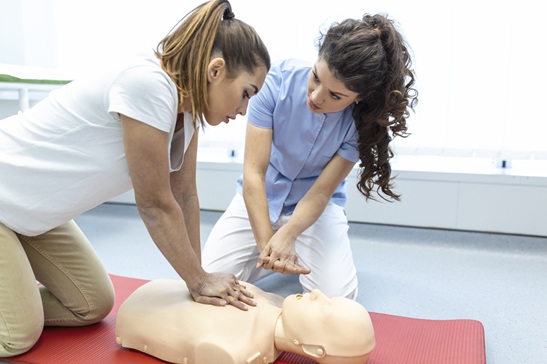
Emergencies can happen suddenly, and prompt, skilled first aid can be the difference between life and death. The Intermediate Emergency First Aid Responder programme builds directly on Basic Emergency First Aid, equipping responders with the knowledge and practical skills to handle medical, trauma and environmental emergencies effectively — stabilising patients, preventing further injury, and supporting both the patient and their family until advanced medical care arrives.
This intermediate-level course enhances the quality of emergency care by preparing learners to act confidently as Intermediate Emergency First Aid Responders: providing life-saving treatment, managing incident scenes, coordinating with emergency services, and offering patient and family support in both workplace and community settings.
Course Duration
2 Days
Entry Requirements
Skills Certificate: Basic Emergency First Aid Responder, NQF Level 2 (SP-230801).
Course Objectives
On completing this Intermediate Emergency First Aid Responder programme, learners will be able to:
Assess and secure the safety of an incident scene, and evaluate patient conditions within their scope of practice
Provide intermediate life support, including CPR and AED use, and conduct secondary assessments for life-threatening conditions
Administer appropriate wound care within the scope of practice
Deliver intermediate first aid for a range of medical emergencies
Manage common environmental emergencies, such as hypothermia and hyperthermia
Safely hand over patients to advanced medical personnel, ensuring accurate documentation
Communicate effectively with patients, their families, and other stakeholders
Perform post-incident clean-up and recovery procedures
Training Methodology
Our diverse instructional approaches ensure effective learning:
– Lectures & Presentations: Engage with expert-driven, stimulating content. – Course Material: Access well-crafted supporting resources. – Group Work: Collaborate on discussions and case studies for practical insights. – Workshops & Role-Play: Participate in immersive, scenario-based activities. – Practical Application: Focus on applying theoretical knowledge in real situations. – Post-Training Support: Receive extensive support after training for skill implementation.
Training Outline
Module 1: Principles of Intermediate First Aid
Importance of intermediate first aid
ABCs: Airway, Breathing, Circulation
Role and limits of a First Aid Responder
Legal and ethical considerations
Personal safety and PPE
Module 2: Applying First Aid
Ensure scene safety
Assess and monitor patient condition
Communicate with patients, bystanders and emergency services
Hand over to medical personnel
Record and report incidents
Post-incident clean-up
Module 3: Basic Anatomy & Physiology
Overview of the major body systems: respiratory, cardiovascular, nervous, musculoskeletal, integumentary, gastrointestinal and genitourinary.
Module 4: Emergency Recognition & Management
Primary and secondary assessments
Manage bleeding, shock, burns and trauma
CPR, AED and choking management
Care for unconscious patients
Respond to cardiac, stroke, diabetic, allergic, seizure, asthma, thermal, poisoning and water emergencies
Reduce communicable disease risks
Module 5: Practical Skills
Scene assessment and hazard management
CPR and AED for all ages
Recovery position for unconscious patients
Treat traumatic and medical emergencies effectively
Certification
Learners who successfully complete the programme will be eligible to write the FISA examination. Upon passing, they will be awarded a Certificate of Competence along with a Statement of Results, both aligned with QCTO standards.
Discover how our courses enhance professionals’ effectiveness in their workplaces.
No reviews found. Add reviews from the dashboard or switch source to Manual.
FAQs – Intermediate Emergency First Aid Responder
Develop intermediate first aid responder skills covering patient assessment, CPR, emergency care, injury management, scene safety, and workplace first aid procedures.
What is the Intermediate Emergency First Aid Responder Skills Programme?
The SP-230802 Intermediate First Aid Responder Skills Programme is an NQF Level 3 programme with 5 credits, designed to develop intermediate skills for managing medical, trauma and environmental emergencies.
Who should attend the Intermediate Emergency First Aid Responder programme?
The programme is suitable for designated workplace first aiders, safety representatives, site supervisors, emergency response team members and employees working in moderate- to high-risk environments.
What topics are covered in the Intermediate Emergency First Aid Responder programme?
Topics include scene safety, patient assessment, CPR and AED use, wound care, bleeding, shock, burns, trauma, choking, unconscious patients, medical emergencies and environmental emergencies.
What are the entry requirements for the Intermediate Emergency First Aid Responder programme?
Learners should have completed the Basic Emergency First Aid Responder Skills Programme at NQF Level 2 before enrolling for the Intermediate First Aid Responder programme.
Does the Intermediate First Aid Responder programme include practical training?
Yes. The programme includes practical activities covering scene assessment, hazard management, CPR and AED use for all ages, recovery positioning and the treatment of medical and traumatic emergencies.
How is the Intermediate First Aid Responder programme assessed?
Learners who successfully complete the programme become eligible to write the Final Integrated Summative Assessment (FISA). Successful candidates receive a Certificate of Competence and Statement of Results aligned with QCTO standards.