
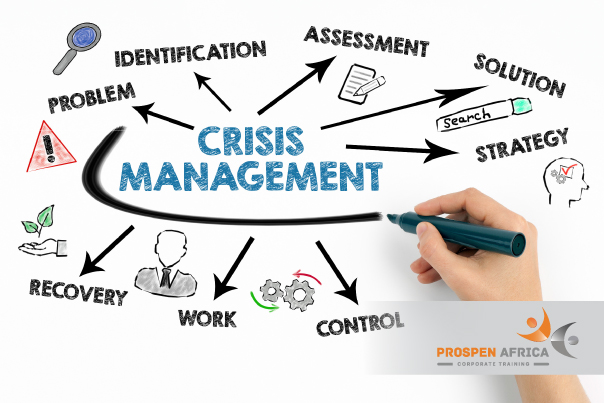
Crisis Management and Communication Workshop

Crisis Management and Communication Workshop

Develop Strategies, Craft Messages, Identify Stakeholders, and Respond with Confidence in a Crisis

|
Platform:
Online
In-class
Revised and Updated: 23 October 2026
Date Venue Duration
14 - 15 December 2026 Live/Online 2 Days
25 - 26 January 2027 Sandton, Gauteng 2 Days
15 - 16 April 2027 Live/Online 2 Days
02 - 06 August 2027 Sandton, Gauteng 5 Days

Course Introduction

In times of crisis, organisations must be responsive, not reactive — organised and effective in communicating with stakeholders. Today, that response also has to hold up in real time on social and digital channels, where a crisis can escalate within minutes of the first post or headline. In this course, we start by defining crisis communication and then empower participants to learn what to communicate, to whom, through which channels, and by when in any instance.

Delegates learn how to be proactive in advance of any crisis and reflective post-crisis, and are empowered with tools, templates, action plans and actual role-playing to develop their ability to be effective and efficient in crisis communications — across traditional media, social media and digital platforms. The Crisis Management and Communication Workshop, run in a workshop setting, includes case studies, stakeholder identification, digital and social media monitoring, and best practices for message creation and delivery to ensure great results for the organisation.

Course Duration Options

This Crisis Management and Communication Workshop is available in two formats, so you can choose the depth that fits your time and needs:

2-Day Workshop Core Foundations

Covers the essential crisis communication skills and tools — crisis dynamics, strategy formulation, stakeholder and team coordination, response systems, digital/social media monitoring, message creation, and a mock crisis exercise.

Course Objectives

By participating in our Crisis Management and Communication Workshop, participants will learn to:
  • Understand crisis dynamics and the stages of crisis communication
  • Apply escalation protocols across traditional, social and digital media
  • Formulate a crisis communication strategy and identify key stakeholders
  • Identify the crisis communication team and their roles: who does what in a crisis
  • Coordinate with top management and other departments
  • Apply crisis communication response systems and protocols best practice
  • Create crisis resources such as manuals and online platforms
  • Monitor and respond to social media and digital channels during a crisis, and manage online reputation
  • Create decisive crisis messages and holding statements
  • Handle media interviews and represent the organisation confidently as a spokesperson (5-Day Comprehensive)
  • Lead structured post-crisis review and reputation recovery (5-Day Comprehensive)
  • Review case studies: examples and consequences of strong and weak crisis communication in practice

Who should attend?

This Crisis Management and Communication Workshop is recommended for all those involved in planning, preparing and responding to a crisis affecting an organisation, whether as executive managers, spokespeople, communication professionals, or those managing an organisation’s social media and digital presence. The 5-Day Comprehensive programme is particularly suited to designated spokespeople and crisis team leads who require media-facing and reputation-recovery skills in addition to the core crisis communication foundations.

Technical Courses

Training Methodology

Our diverse instructional approaches ensure effective learning:

– Lectures & Presentations: Engage with expert-driven, stimulating content.
– Course Material: Access well-crafted supporting resources.
– Group Work: Collaborate on discussions and case studies for practical insights.
– Workshops & Role-Play: Participate in immersive, scenario-based activities.
– Practical Application: Focus on applying theoretical knowledge in real situations.
– Post-Training Support: Receive extensive support after training for skill implementation.

Training Outline

2-Day Workshop — Training Outline

Day 1 — Foundations, Strategy and Team Coordination
  • Definition, importance and dynamics of crisis communication; stages and escalation protocols
  • Approaches to formulating a crisis communication strategy and identifying stakeholders
  • Aligning traditional, social and digital media within one strategy
  • Identifying the crisis communication team and roles; coordination with top management
  • Case Study: Examples and consequences of strong and weak crisis communication in practice.
Day 2 — Systems, Messaging, Monitoring and Mock Exercise
  • Crisis communication response systems, protocols and crisis resources
  • Social media and digital monitoring for early warning and sentiment tracking, including AI-assisted monitoring with human review
  • Creating decisive crisis messages, holding statements and communication templates
  • Essentials of handling media and spokesperson questions under pressure
  • Practical Exercise: Conducting a mock crisis exercise, including a social media escalation scenario, with reflective debrief.

5-Day Comprehensive — Training Outline

Day 1 — Module 1: Foundations of Crisis Communication and Crisis Dynamics
Introduction to Crisis Communication
  • Definition and importance of crisis communication
  • The difference between responsive and reactive communication
Crisis Dynamics and Stages
  • Understanding crisis dynamics
  • Stages of crisis communication
  • Escalation protocols, including how quickly a crisis can escalate on social and digital media
  • Case Study: Examples and consequences of strong and weak crisis communication in practice.

Day 2 — Module 2: Strategy, Stakeholders and Team Coordination
Strategy Formulation
  • Approaches to formulating a crisis communication strategy
  • Stakeholder identification and communication
  • Aligning traditional, social and digital media within a single crisis communication strategy
Crisis Team Coordination
  • Identifying the crisis communication team and roles
  • Coordination with top management and interdepartmental communication
  • Decision-making authority and sign-off protocols during a live crisis
  • Practical Exercise: Mapping a crisis communication team and stakeholder list for participants' own organisations.

Day 3 — Module 3: Systems, Protocols and Digital/Social Media Monitoring
Systems and Protocols
  • Understanding crisis communication response systems and protocols
  • Best practices for creating and maintaining crisis resources such as manuals and online platforms
Digital and Social Media Monitoring
  • Social media and digital monitoring tools for early warning and sentiment tracking
  • Using AI-assisted monitoring and listening tools to flag emerging issues, with human review before any public response is issued
  • Identifying misinformation and coordinated online attacks, and responding appropriately
  • Practical Exercise: Setting up a basic social media monitoring and escalation protocol.

Day 4 — Module 4: Message Creation, Media Handling and Spokesperson Training
Message Creation and Delivery
  • Creating decisive crisis messages and holding statements
  • Developing communication templates and action plans
  • Adapting messages for media, social channels and internal audiences
Media and Spokesperson Training
  • Preparing for and handling media interviews under pressure
  • Bridging techniques and staying on message during difficult questioning
  • Body language, tone and on-camera/on-air presence for spokespeople
  • Practical Exercise: Filmed mock media interview with individual feedback.

Day 5 — Module 5: Mock Crisis Simulation and Post-Crisis Reputation Recovery
Mock Crisis Exercise
  • Conducting an extended, multi-stage mock crisis exercise, including a social media escalation scenario
  • Role-playing exercises to simulate crisis scenarios across departments
Post-Crisis Reputation Recovery and Review
  • Managing online reputation in the aftermath of a crisis
  • Structured post-crisis review: what worked, what didn't, and lessons learned
  • Updating crisis manuals, protocols and messaging based on review findings
  • Reflective session on action plans and role effectiveness
Course Wrap-Up
  • Individual action plans for strengthening crisis communication readiness in participants' own organisations.

Course Categories

Get a Quote Banner Outline

Request a Call Back

Your submission has been successful

Please check your email for confirmation

Success Stories

Discover how our courses enhance professionals’ effectiveness in their workplaces.

Northam Booysendal

Advanced Business and Report writing skills Training

The training facilitator started the training with a quote that captivated my attention from the start. The way he spoke and the examples he used were very important to me in general and in the training. The training was set in a way that I could understand the key points of effective Report Writing. The training was of such etiquette that anyone would be able to understand and implement what was learned. Thank you, Rock - Your course was amazing and your style for training is next level.

FAQs – Crisis Management and Communication Workshop

Prepare for effective crisis management and communication with practical training in crisis planning, response strategies, stakeholder communication, media management, and reputation protection.

What is covered in the Crisis Management and Communication Workshop?
The workshop covers crisis dynamics, communication strategies, escalation protocols, stakeholder identification, crisis team coordination, response systems, message creation, holding statements and crisis response planning.
Who should attend the Crisis Management and Communication Workshop?
The workshop is suitable for executive managers, spokespersons, communication professionals and others involved in planning, preparing for or responding to organisational crises.
Does the Crisis Management and Communication Workshop cover crisis communication strategies?
Yes. Participants learn how to formulate crisis communication strategies, identify stakeholders, establish escalation protocols and coordinate communication with management and other departments.
Does the Crisis Communication course cover crisis messages and holding statements?
Yes. The workshop teaches participants how to create decisive crisis messages, holding statements, communication templates, resources and action plans for effective crisis response.
Does the Crisis Management and Communication Workshop cover crisis team roles and coordination?
Yes. Participants learn how to identify crisis communication team members and responsibilities, coordinate with top management and improve interdepartmental communication during a crisis.
Does the Crisis Management and Communication Workshop include practical exercises?
Yes. The Crisis Management and Communication Workshop includes role-play, case studies, group work and a mock crisis exercise, allowing participants to practise crisis communication, message delivery, coordination and response planning.

Related Courses

Your submission has been successful

Please check your email for confirmation