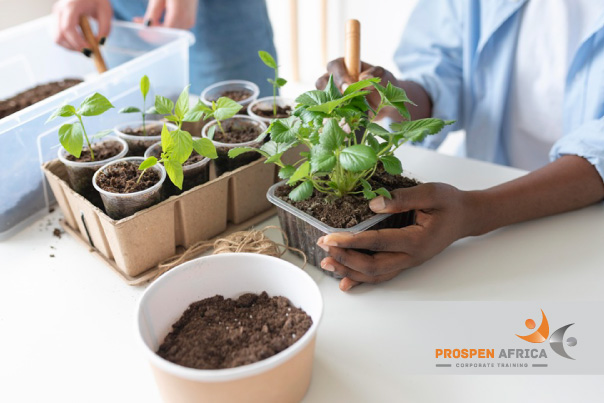
Regenerative agriculture goes beyond minimising harm. It aims to rebuild soil health, restore ecosystems, and strengthen farm productivity, profitability, and resilience to climate stress. This advanced course equips agricultural professionals with practical, evidence-based skills in no-till and reduced tillage, cover cropping and rotations, planned grazing, composting and biological inputs, agroforestry, and water management.
Participants learn to design whole-farm systems that build soil organic matter, use water efficiently, support biodiversity, and create sustainable livelihoods. The course is honest about evidence: results depend on soil, climate, and management, and claims about soil carbon need careful measurement. Participants also examine economics, markets, certification, and policy, and leave with a transition plan for their own farm or project.
Course Objectives
By the end of this Regenerative Agriculture: Advanced Practices for Soil Health and Ecosystem Renewal Training course, participants will be able to:
Explain the core principles of regenerative agriculture and how it compares with conventional and other sustainable approaches, and the evidence for its benefits
Implement no-till and reduced tillage systems to build resilient soils
Use cover cropping and diverse rotations to improve fertility and manage pests
Plan grazing systems to restore grasslands and increase biodiversity, and monitor their effects
Develop strategies for building soil organic matter, and understand the limits and measurement of soil carbon sequestration
Produce and use compost and biological inputs for nutrient cycling, within the relevant regulations
Integrate trees and perennials with crops and livestock (agroforestry)
Manage water to conserve resources, improve infiltration, and build drought resilience
Integrate livestock for soil and ecosystem health, with attention to animal welfare
Enhance biodiversity and ecosystem services, such as pollination and natural pest control, and measure them on the farm
Monitor, assess, and manage soil health using field and laboratory methods
Evaluate the economics, market opportunities, and certification pathways for regenerative produce
Design a transition plan for adopting regenerative practices, and learn from case studies and emerging policy
Who should attend?
Farmers and Farm Managers
Agricultural Consultants and Extension Officers
Environmental Scientists and Land Managers
Sustainability Officers
Policymakers and Researchers
NGO Staff
Training Methodology
Our diverse instructional approaches ensure effective learning:
– Lectures & Presentations: Engage with expert-driven, stimulating content. – Course Material: Access well-crafted supporting resources. – Group Work: Collaborate on discussions and case studies for practical insights. – Workshops & Role-Play: Participate in immersive, scenario-based activities. – Practical Application: Focus on applying theoretical knowledge in real situations. – Post-Training Support: Receive extensive support after training for skill implementation.
Training Outline
Day 1 — Foundations and the Living Soil
Module 1: Regenerative Agriculture Foundations
Defining regenerative agriculture compared with conventional, organic, and other sustainable models
Principles: soil health, biodiversity, systems thinking, context, and feedback
What the evidence shows, where it is strong, and where it is still debated
Practical Exercise: describe your farm or project against the regenerative principles and identify gaps
Module 2: The Living Soil: Foundations for Regeneration
The soil food web and ecosystem functions
Soil health indicators and soil organic matter
Diagnosing soil degradation, erosion, and recovery
Practical Exercise: carry out a basic field soil assessment and record the results
Day 2 — Disturbance, Cover and Rotations
Module 3: Minimising Disturbance: No-Till and Reduced Tillage
Techniques, equipment, and benefits, and the trade-offs and risks
Crop residue management and weed control, including the role and limits of herbicide use in no-till
Practical Exercise: design a reduced-tillage plan for one field
Module 4: Enhancing Fertility: Cover Cropping and Rotations
Cover crop species selection for local climate and soils
Rotation strategies for fertility and pest management
Practical Exercise: select a cover crop mix and a rotation for a sample farm
Day 3 — Grazing and Natural Amendments
Module 5: Restoring Grasslands: Planned Grazing
Principles and planning for grazing systems, including stocking rate, rest, and recovery
Monitoring livestock and ecosystem impacts, and what the research says about different grazing systems
Practical Exercise: draw up a grazing plan and a monitoring set-up for a sample paddock system
Module 6: Natural Amendments: Composting and Biofertilisers
High-quality compost production and quality checks
Biofertilisers for nutrient cycling and soil health, and the relevant registration and labelling rules in South Africa (Act 36 of 1947 for fertilisers, farm feeds, and agricultural remedies; confirm current requirements)
Practical Exercise: prepare a compost heap and plan its use
Day 4 — Agroforestry and Water
Module 7: Agroforestry: Integrating Trees and Perennials
Designing agroforestry systems for local conditions
Integrating crops, livestock, and trees, and invasive alien plant considerations
Practical Exercise: design an agroforestry layout for part of a farm
Module 8: Water Management: Conservation and Resilience
Rainwater harvesting and efficient irrigation, and the legal framework for water use (National Water Act)
Water retention in soils, infiltration, and drought resilience
Practical Exercise: measure water infiltration and plan a water-capture improvement
Day 5 — Livestock and Biodiversity
Module 9: Livestock Integration: Synergies and Benefits
Livestock roles in regenerative systems
Rotational grazing, manure management, and animal welfare
Practical Exercise: plan the integration of livestock into a cropping system
Habitat creation, pollinator support, and natural pest control
Measuring on-farm biodiversity
Practical Exercise: survey a field edge for biodiversity indicators and propose habitat actions
Day 6 — Soil Health Monitoring and Assessment
Module 11: Soil Health Monitoring and Assessment
Visual and laboratory soil assessments, such as aggregate stability, infiltration, organic carbon, and biological activity
Sampling design, baselines, and re-testing over time; why soil carbon changes are slow and hard to measure
Soil health planning and technology tools, including remote sensing and digital records
Practical Exercise: set up a soil monitoring plan with baseline sites and a testing schedule
Day 7 — Economics and Markets
Module 12: Economics of Regeneration: Market Opportunities
Economic analysis and profitability, including costs, yield changes during transition, and input savings
Market trends, certification schemes, and business models
Carbon and other environmental markets: how they work, what is measured, and the risks of overstated claims
Practical Exercise: build a simple partial budget comparing current and regenerative practice for one enterprise
Day 8 — Transition Strategies
Module 13: Transition Strategies: Planning and Implementation
Transition planning and change management, starting small and scaling
Overcoming challenges, finance and risk, and building networks and peer learning
Practical Exercise: draft a three-year transition plan with first-season actions
Day 9 — Case Studies
Module 14: Case Studies: Leading Regenerative Farms and Systems
Lessons from global and regional pioneers
Documented impacts, innovative practices, and practitioner interviews, with site visits or guest practitioners where available
Practical Exercise: analyse a case study and list what would and would not transfer to your context
Day 10 — The Future of Regeneration and Your Plan
Module 15: The Future of Regeneration: Innovation and Policy
Emerging technologies, trends, and research
Policy frameworks, incentives, and building resilient food systems, including relevant South African land and agricultural resource legislation, such as the Conservation of Agricultural Resources Act
Practical Exercise: present your transition plan and receive peer feedback
Who should attend this Regenerative Agriculture Course?
This training is designed for commercial farmers, agricultural advisors, agronomists, land management specialists, environmental consultants, and farm operations managers aiming to transition to sustainable, regenerative farming systems.
How does this program focus on improving soil health and structure?
Delegates gain practical insight into living root management, organic matter enhancement, soil biological testing, water infiltration improvement, and reducing chemical input dependence to build resilient soil ecology.
Will delegates learn about agricultural carbon credits and sequestration?
Does the course address livestock integration and managed grazing?
Yes. The program explores high-density rotational grazing, adaptive multi-paddock (AMP) grazing, and integrating livestock with cropping systems to accelerate soil regeneration and pasture vitality.
Why is adopting regenerative agriculture practices beneficial for farm profitability?
Regenerative practices improve drought resilience, lower input costs for fertilizers and pesticides, stabilize crop yields under extreme weather conditions, and access premium markets for sustainably produced commodities.